![]() |
Xunantunich Maya Ruins
Belize |
|||||||
Essentials |
Paying taxes is hardly pleasant, but I prefer it to what the Maya people of Xunantunich (pronounced “zoo-NAN-too-NICH”) in western Belize owed their government. Their rulers required every family sacrifice a child on their behalf. But that was only part of it. Whenever it was time for these same rulers to perform fertility rituals, they utilized young Maya women for genuine and ceremonial killings.
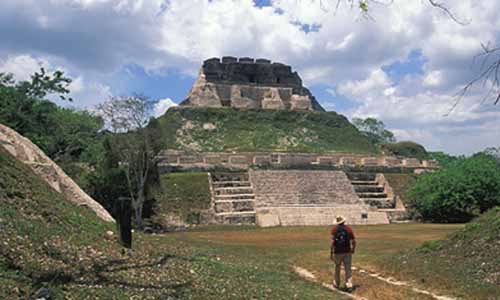
A place with so much bloodletting deserves a few ghosts, and perhaps it was one of the sacrificed maidens that once materialized where I stand now, at the base of the 130-foot high stone pyramid known as El Castillo, the second tallest Maya structure in Belize. According to
the story, a hunter at the end of the 1800s was passing
the pyramid at sunrise when he was startled by the appearance of beautiful
maiden wearing traditional Maya clothing.
The story became a popular one, and so the name of the site was changed from Benque Viejo to Xunantunich, usually interpreted as “the place of the Stone Maiden” in Mayan. Yet the hunter's tale makes it clear the woman was flesh and blood female. Perhaps a more accurate though less common translation of Xunantunich is “Maiden of the Rock,” which better matches the legend. As one of the largest structures ever built in either modern or ancient Belize , El Castillo begs to be climbed. So I follow a steep marked path up the right side that leads to a broad grass terrace beside a temple section ornamented with a frieze containing stucco figures that dwarf me. It's remarkable that such an elaborately decorated pyramid was ever constructed here. Although Xunantunich was first settled somewhere between 200A.D. and 500 A.D., it didn't become an important city until the Late Classic Period (700-900 A.D.), a time when most other Maya cities were collapsing. Yet Xunantunich suddenly grew and prospered, building this mammoth pyramid. The friezes originally encircled El Castillo, but unfortunately only portions of the western and eastern sides still remain intact. These friezes, however, look brand new, exhibiting few signs of weathering despite the passing of centuries. A guide standing nearby says what I see are actually replicas placed over the originals to preserve them. Archaeologists say the friezes depict astronomical themes related to rulership and the accession of power. One mask with big ears and ear ornaments is supposed to represent the sun god. Signs for the moon, the planet Venus and different Mayan days are also displayed. Yet to be explained is the unknown, unidentified man who was beheaded for some reason. I like to think it depicts how paybacks can be a bitch, that it's a ruler the common people decided should be handed his own head. When Xunantunich was partially destroyed by an earthquake, the people took it as a sign that the gods were displeased with them despite all the human sacrifices. They lost faith in their leaders, revolted and apparently beheaded at least one ruler before abandoning the location. The terrace with the friezes is still a long way from the top of El Castillo. The ascent requires climbing up small steps and navigating narrow walkways, even passing the room where the rulers once slept every night. From my new vantage point, I can finally appreciate the remarkable compactness of Xunantunich. The six major plazas and 25 temples and palaces of the main square are packed in an area less than 325 square yards. Out of sight and hidden by the trees are the residential structures built on the surrounding hillside. El Castillo was strategically located on a hilltop, which allowed it to tower even higher over the Mopan and Belize River valleys below. It's amazing how far I can see, if not quite far enough to pick out Tikal , the huge Maya complex in Guatemala only 30 miles away. The Maya rulers certainly knew where to build a room with a view. I'd gladly spend the night up here, too. Xunantunich was the first major archeological site opened to the public, in 1954, and since has come to symbolize the Maya heritage of Belize . Most tour companies in Belize City offer day tours to Xunantunich combined with a stop at the Belize Zoo (on the way) for about $80 per person. Or rent a car and make the two-hour, 80-mile drive on your own. Signs may be lacking but there aren't that many wrong turns to make. To reach Xunantunich it's also necessary to cross the Mopan River on a hand-cranked ferry. The ferry can take one vehicle across at a time, and you might want to take yours to avoid the steep 20 to 30 minute climb from the riverbank to the ruins entrance. The ferry operates from 8 a.m. to 5 p.m. |
|||||||